
Reflections On The Evolution Of Irish Company Law Enforcement
Address By Senator Michael McDowell SC
To
Corporate Enforcement Authority Conference
25th Anniversary of the Company Law Enforcement Act 2001
11th September 2026
Convention Centre Dublin
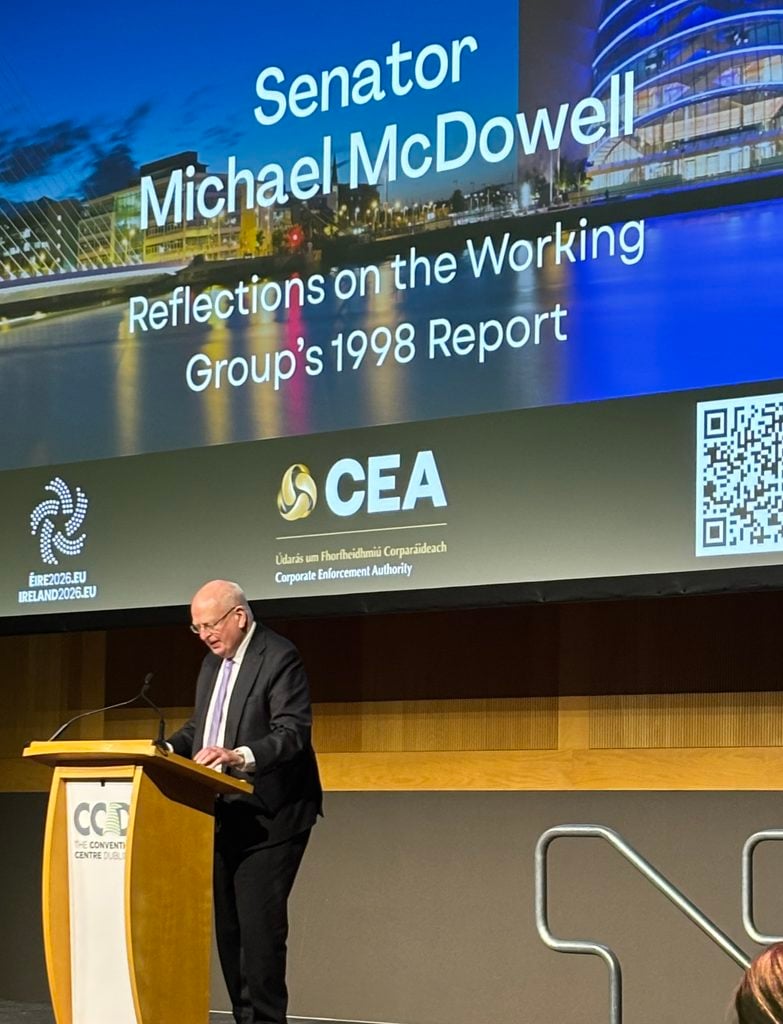
I want to thank the Corporate Enforcement Authority for its kind invitation to address this 25th Anniversary Conference on the Act of 2001.
Twenty-five years seems a long time and is perhaps a full lifetime for many people here today.
I will however start my contribution with a few words concerning my personal involvement with Irish company law.
My first brush with company law was in my final year of studies in King’s Inns in 1973-4, more than half a century ago.
I vividly remember the very first day in October 1973 of the Company Law course given by Prof Charles Lysaght in a lecture room in King’s Inns. On that occasion, at the very outset of the lecture, a hand went up towards the back of the class.
A student of mature years asked Prof Lysaght if that student could be excused attendance at the company law lectures because he had already studied company law for his primary degree and for his professional qualification in accountancy.
Prof Lysaght replied somewhat languidly that even he might benefit from attending the lecture course which would deal with topics which he had probably not encountered in his earlier academic career. The somewhat impudent student went on to hold high office in a major financial institution.
That student was Michael Fingleton. Need I say more?
Having qualified as a barrister, I practised in Dublin and was elected to Dáil Éireann on two occasions from 1987 to 1989 and from 1992 to 1997 as a Progressive Democrat TD. In 1997, I lost my seat in Dublin Southeast by a margin of 27 votes.
A year later, in the summer of 1998, the then Minister for Enterprise, Trade and Employment, Mary Harney TD, contacted me to ask if I would chair a group that the Government intended to form to deal with the reform of company law enforcement and compliance.
The decision, she stated “was influenced by the recent emergence of strong indications of abuses of company law which pose a particular problem for the integrity of company regulation. The consequential public concerns must be allayed if the social consensus and Ireland’s standing as a reputable place to do business which underlies our present economic success are to be maintained in the future”.
I happily agreed to serve. The terms of reference of the Working Group were comprehensive and demanding. The group was to report by the 30th November 1998. Effectively we had just three months, September, October, and November, 1998 to complete our task. I enjoy working to deadlines.
The political background to the establishment of the group was the series of major corporate scandals which had seriously undermined public confidence in the substance and administration of Irish company law. The Group’s membership of 25 diverse persons representative of social partners, and of Irish corporate and legal worlds, and of public servants may have appeared unwieldy but the team spirit and demanding deadline, aided by an efficient secretary, Philip Donegan, allowed us to plunge into our task and complete our business and duly present our report on the 30th of November 1998.
As one author has put it, the Group “first met in September 1998 and produced its report on the 30th of November of the same year, a remarkable achievement by any standard. Even more extraordinary by Irish legislative standards, was the speed with which the recommendations of the McDowell Group were adopted by the Oireachtas and passed into law in 2001”.
One member of our group was extremely valuable to our research and deliberations. He was Tom Courtney, the author of a major textbook on the law of Irish private companies. My friendship with Tom originated in a letter which I sent him expressing my admiration for his recently published brilliant textbook, The Law of Private Companies.
I asked the Tánaiste Mary Harney to ensure that he was made a member of our group. And so commenced his immeasurable public contribution to Irish company law development and reform. We are all greatly in his debt for his service to the Irish State in this field. The 5th edition of his masterly work, The Law of Companies, is due to be published in the very near future.
The Group approached its task observing a number of principles. Limited liability is designed to encourage and foster honest enterprise by permitting promotion and investment in ventures and at the same time limiting the consequence of failure.
Limited liability acknowledges the inevitability of some commercial failures in any enterprising society.
The purpose of company law, we said, is “neither to prevent nor to ensure against – still less punish – commercial failure”.
The privilege of limited liability demands in return that such a privilege be confined to those who act in good faith and abide by a minimum discipline of corporate governance and commercial probity.
Company law, we said, also requires that those who avail of the privilege of incorporation to obtain limited liability should afford to the world at large such information as will enable third parties to assess the risks of dealing with them.
The purpose of company law, we stated, was to give “on paper at any rate, the reasonable reassurance that abuse of incorporation will entail both criminal and civil liability”.
We argued that Ireland “as a successful enterprise of the European Union, needs and deserves a system of company law which is both effective and practical.
Paper obligations and paper remedies will not suffice. Those who avail of incorporation have nothing to fear from enforcement of the laws under which they operate: the community, by contrast, has much to fear and to lose if the legal regulation of corporate activity exists only on paper and has no practical effect.”
Having set out the advantages of enforcement and compliance, we stated that a compliant corporate sector “should yield substantial returns in business efficiency, solvency, revenue yield, social solidarity and in terms of public and private time saved in dealing with the consequences of non-compliance.”
We also pointed out that compliance and transparency were beneficial to companies and businesses themselves, and likely to enhance rather than impede their success in the long-term.
To these ends, the group emphasised that no new “draconian regime” or “explosion in corporate investigations” was necessary. Simplification and effectiveness was what was required.
We pointed out that the provisions Irish company law was then to be found in a lengthening series of statutes and statutory instruments which were complex and increasingly formidable to experts and lay persons alike. To that end we recommended codification of Irish company law and set out the steps and a timetable that were needed to achieve that aim.
In 1998, we found that the compliance rate by companies in filing their annual returns with the Companies Registration Office was abysmal. In 1997, only 13% of companies had filed returns within the due date and less than 40% of companies filed their annual returns within the calendar year prescribed.
We found that more than 40% of companies on the CRO register were not trading and, allowing for that, the “on time” compliance rate was between 20% and 30% in recent years.
Compliance was widely regarded as some counsel of perfection; non-compliance was essentially without consequence.
Company law compliance had degenerated into a slum squatted in by persons who to took full advantage of its derelict state.
As regards enforcement, the remedies were largely ineffectual. Companies could only be struck off when two or more years in default in filing an annual return. Prosecutions of a company or its officers required to be initiated by the Minister for Enterprise Trade and Employment in the courts, and the remedy of disqualification from holding office in a company followed the commission of three offences under the Companies Acts.
The strike-off process was already being galvanised by the energetic Paul Farrell, Registrar of Companies, and was set to be revolutionised with 35,000 companies to be warned of strike-off by the end of 1998 and all other companies in 1999.
Prosecutions for failure to file returns had dwindled from 1,979 in 1994. to 626 in 1995, to 43 in 1996, and to zero in 1997. Fines imposed for failure to returns had diminished from over £2 million in 1994 to £16,000 in 1996. Prosecutions of directors for non-compliance had similarly slumped.
Bearing in mind the rigorous requirements of criminal justice, any attempt to secure general compliance through the criminal process alone was likely to be ineffective.
We discovered that for the first and only time a liquidator was prosecuted in 1996 for failure to file liquidator’s returns under the Companies Act 1963.
All the foregoing was merely symptomatic of a bleak landscape of non-enforcement and abuse of incorporation. The phenomenon of the “phoenix company” which enabled successive corporate enterprises to continue trading leaving creditors badly damaged was well known to the Irish public and was not being adequately addressed, let alone curtailed.
Because Irish law provided no jurisdiction for someone like the official receiver in the UK to institute winding up processes with a view to recovering assets and imposing personal liability in cases where there were no prospects of remunerating a court appointed liquidator due to the non-availability of funding,
the phoenix syndrome was accompanied by what was termed the “scorched earth” strategy of leaving nothing behind for a court appointed liquidator to use to finance a proper winding-up, recovery of assets, and imposition of liability on those responsible.
It was clear to the members of the Working Group that a dedicated public office should be created for enforcement in civil and criminal in company matters. This idea had been mooted in a previous report of the company law review group published in February 1995.
The 1995 Report suggested that such a public office should be an “executive unit located within the Department of Enterprise and Employment”. But we went further and proposed the creation of an independent statutory office, to be known as the Director of Corporate Enforcement.
Time has clearly shown that this approach recommended by us was perhaps overly conservative and we now have a Corporate Enforcement Authority to perform the functions previously performed by the Director of Corporate Enforcement (the “CEA”).
Instead of a single officer, we now have a body corporate. It is not my intention here to consider the more recent history of the new body established under the Companies (Corporate Enforcement Authority) Act 2021.
Suffice it to say that I have no doubt now that a dedicated and fully professional agency with adequate means of investigation is necessary and that the CEA needs the resources, power and authority to enforce civil and criminal liabilities of persons abusing company law and limited liability.
It is equally important that the activities of receivers and liquidators appointed by the courts and liquidators in voluntary liquidations are supervised and obliged to comply with their legal duties.
I understand that it is intended to ensure that liquidators, however appointed, simply cannot “walk off the site” leaving bodies corporate in a zombie-like, undead state.
The rate of compliance with company law obligations has dramatically improved since the implementation of the Working Group’s recommendations.
During the interval between the publication of the Working Group’s report and my appointment as Attorney General in the following July, I lost no opportunity to emphasise the importance of implementing our report for the good of the country.
I was determined to ensure that our report did not languish gathering dust on the shelf of good intentions. I attach to these pages two speeches I made at the time.
I was appointed as Attorney General in July of 1999 and served in that office until June 2002. I was happily in a position to keep a close eye on the drafting as a matter of urgency of Tánaiste, Mary Harney’s, Company Law Enforcement Act 2001, which was signed into law on the 9th of July 2001.
That Act established the office of Director of Corporate Enforcement and set out the functions and powers of the officeholder. It transferred nearly all ministerial enforcement powers to the Director and provided investigatory powers for authorised officers to be appointed in respect of individual companies in accordance with our recommendations.
The role of the courts was enhanced to enable proper supervision and control of the affairs of insolvent companies.
It also amended the law of criminal evidence as it applies to complex cases involving breaches of company law.
Perhaps most importantly, the Working Group’s recommendations in relation to the establishment of a permanent Company Law Review Group (CLRG) as a statutory body were given effect. Among other things, the CLRG had the power and duty to advise the Minister on reform and consolidation of the Companies Acts on an ongoing basis. Tom Courtney became its first chairperson.
In addition to its ongoing functions of researching and recommending reforms, the CLRG commenced the task of consolidating and codifying Irish company law.
This mammoth task resulted in the publication of a draft consolidated Companies Act by 2007, and notwithstanding the paralytic effects of the financial crisis of 2009 to 2012, the process of enacting the consolidated companies statute proceeded and resulted in the enactment of the Companies Act 2014. This Act has become Ireland’s single companies’ code. It simply would not have happened without the energy and commitment of the CLRG and its chairman, Tom Courtney. The Act was not merely a consolidation but in many, many ways a substantial reforming statute.
The duties of company promoters and directors and other officers, including their fiduciary duties, and the imposition of personal liability for default in such duties have, I believe, made Irish company law not merely more rational, more accessible and more effective, but radically more suitable for the changing economic nature of the Irish and world economies.
The establishment of the CLRG on a statutory basis has the huge advantage that a permanent mechanism has been put in place to keep Irish company law in a fit condition in future to serve both the community and corporate enterprise.
Looking back over the last 25 years, I consider that I was very privileged to be able to play a central role in law reform, both as Attorney General and as Minister for Justice, Equality and Law Reform. I was involved with others in many matters during my tenure of those offices, including major reforming initiatives such as defamation law and the Land Law and Conveyancing Act, the Revised Statutes publication process, police and criminal law reform, and, very much not least, the entire area of company law reform and enforcement.
I finish on this reflection, namely, that law reform is a vital organic process in any liberal and democratic society.
The Duke of Wellington, however reluctantly an Irishman by birth, is famously reported as addressing two centuries ago the issue of reform with the following words:
“Reform? Reform? Aren’t things bad enough already?”
My response to the learned Duke is that while things from time to time may be bad, but they are infinitely worsened in a society that does not grasp the need for reform.
Finally, on the eve of the POTUS visit and with the Phoenix Park closed, I hope that the Wellington monument won’t be renamed this weekend.
– ENDS