
Collins Griffith Commemoration
Glasnevin Cemetery
Sunday 16th August 2026
Graveside oration by Senator Michael McDowell SC
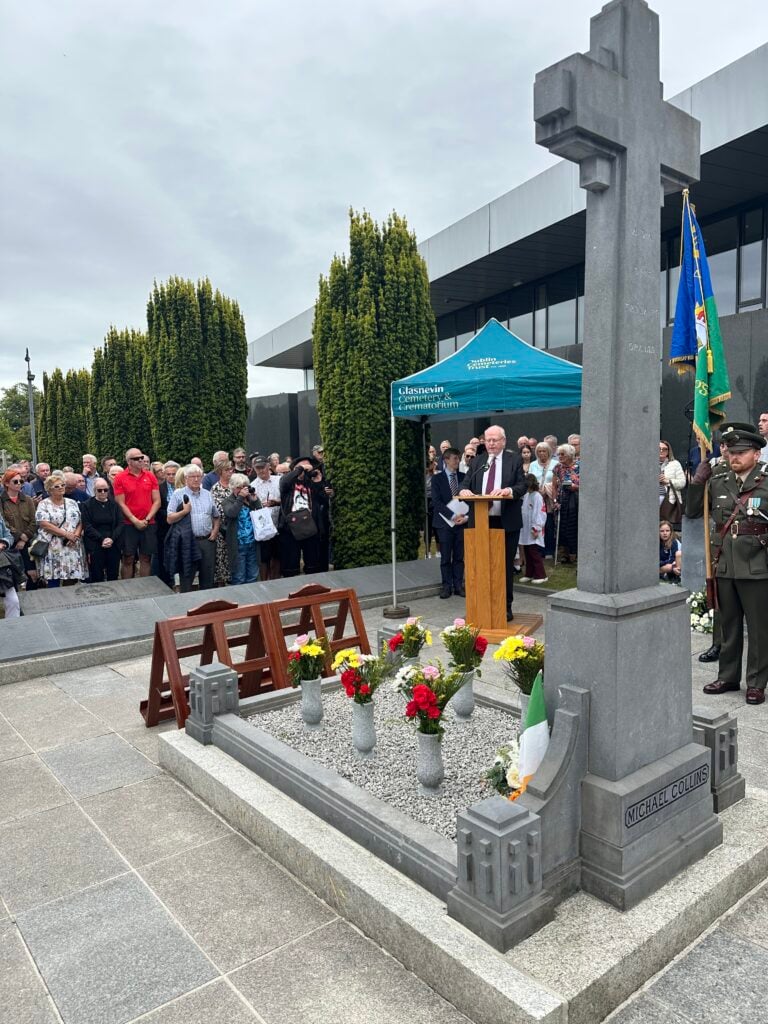
We gather here today in Glasnevin to commemorate two great Irish patriots – Michael Collins and Arthur Griffith.
Their greatness lies in their bravery, judgment and their determination that the dream of Irish nationalists that Ireland would become an independent, democratic state would be realised and that the opportunity to accomplish that dream would not be lost – either at the hands of its age-old opponents or of those extremists who endangered the project of Ireland’s independent democracy by elevating theory above reality.
Here at the grave of Michael Collins, in particular, we remember a young man without whom, it can be confidently said, the armed struggle for Ireland’s independence would either never had ignited or, if it had ignited, would have sputtered out in failure.
None of his generation who bravely struggled in arms or in political action, or both, for their country’s freedom was free from imperfection. And none of them deserve either deification or ingratitude.
But Collins, much more than most, possessed a unique combination of characteristics which demand our admiration.
When in London which was the capital of the greatest power on this planet at the time, he came to understand its power and its methods.
He there joined the Irish Republican Brotherhood, inducted by his fellow republican, the legendary Sam Maguire.
He returned to Ireland and participated in the 1916 Rising with the minor responsibility of guarding a stairway in the smouldering ruins of the General Post Office. But that bitter experience of failure in arms strengthened his determination and taught him, perhaps, the vital difference between idealism and pragmatism.
Others have written accounts of Michael Collins, the central, masterly exponent and coordinator of armed guerilla struggle, intelligence and counter-intelligence, electoral campaigning, and financial and logistical support, which demonstrate beyond doubt his unequalled role in bringing about our freedom as a people.
But those who have criticised his part in those events or doubted his importance – from whatever perspective – often fail to grasp the narrowness of the closing window of opportunity with which Collins and Griffith were confronted in the autumn of 1921.
The very precarity of the Lloyd George coalition, and the very real probability of the Conservative and Unionist party becoming the sole and utterly hostile interlocutor with Irish nationalism, as happened not much later in 1922, were well known to Collins and Griffith. So were the implications.
They clearly understood that the substance of Irish independence might so easily have trickled away through the hesitant fingers of Ireland’s leaders if it were rejected by reference to its form rather than its substance. They understood the responsibility that lay on those who had to choose between establishing Irish independence or joining the long line of patriots who had failed to deliver it.
Above all, they envisaged and enabled the development of Ireland’s modern democracy whose success in so many ways may even surpass what they regarded as its potential.
Their graves are hallowed Irish ground and this grave is the most visited grave not merely in this cemetery but on this entire island. And that is fitting and deserved.
We have gathered here in gratitude for their legacy, in recognition of their greatness, and in expression, above all, of our shared values and beliefs and identities as free citizens of the democratic state which they by their patriotism, bravery and realism established in our name.
Suaimhneas sioraí dóibh.