
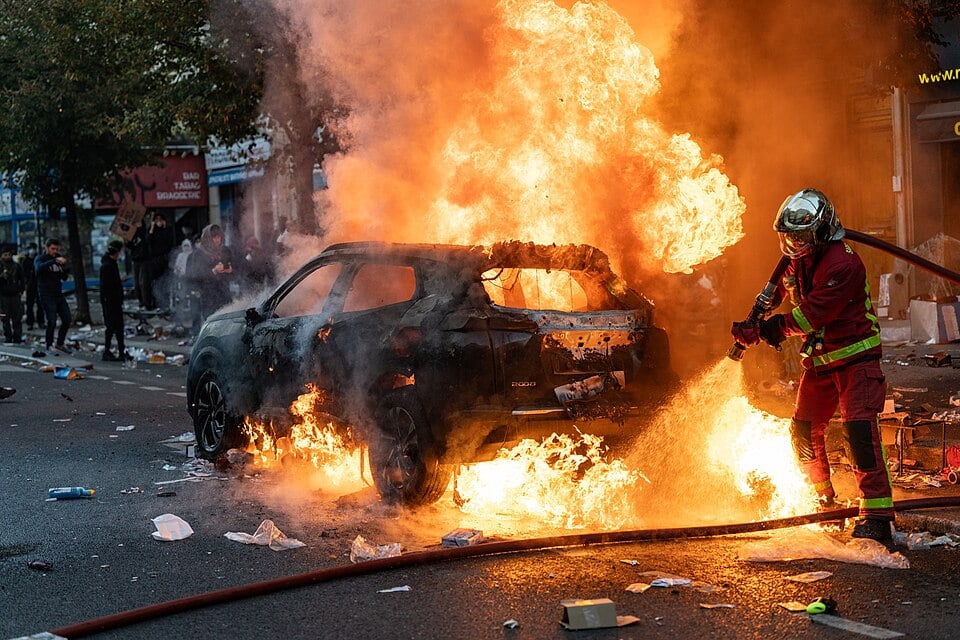
The riots in France are a very serious matter for us all. They are not just some minor, routine, explosive geyser – part of a long-standing French tradition of street protest. Nor are the rioters protesting in sympathy with teenagers venting anger at underinvestment in their lycees.
Some violent, destructive rioters appear to have been co-ordinated by extremists on the far left, who saw mass demonstrations organised by more moderate leftists as an opportunity to further radicalise French politics. All these events serve to deliver French political debate into the hands of the left and right fringes of political opinion – at the expense of centrist politics.
Many millions of decent French men and women look on with dismay at the riots and the kind of political instability they are carefully designed to create. The same applies in Italy in relation to the smaller-scale copycat rioting in Milan. French president Emmanuel Macron’s televised national address in response looked and sounded weak.
Leftist street politics are not a legitimate response to the economic problems facing France, which are chronic and accelerating. Of course, people in democracies have a right to peaceful protest. These are rights that do not exist in the totalitarian states led by despots of the kind that the shameful president Donald Trump claims such warm personal relations with, and mutual respectful admiration for.
In 2024, the French left united to demand earlier retirement ages, increased state expenditure and wealth taxes for the rich, as well as the usual left agenda. While Ireland takes steps to increase economic participation by extending working lives to take account of demography and longevity, left-wing French politicians argue for diminished economic participation, easier economic opt-outs, higher taxation and increased public spending.
It should be no surprise that Marxists favour street politics over democratic means of resolving divisive political issues and determining national politics. The appetite for street politics is not confined to Antifa militants who want physical confrontation to increase their profile, and to radicalise opinion. A craving for simplistic, binary political debate is not the monopoly of the left either.
In Ireland, we see many of the same patterns. On social media, centrist politicians are denounced and mocked as traitors, usually by people availing of online anonymity.
The fuel protests were a case in point. Organisers claimed they were intent on making the State ungovernable by blockading fuel depots. They denied the right of elected politicians to lift their unlawful blockades, which threatened all economic activity and wellbeing.
The protests succeeded insofar as they led to sensible reductions in taxation of fuels as a response to spiralling prices. But the self-appointed leaders wanted more – they wanted to capitalise on the fuel-price concessions made to create some form of incoherent political movement, most probably an alliance of anti-immigration, pro-life, Irexit, religious conservative and anti-homelessness sentiment. So far, that strategy has petered out. Efforts last month to reconvene activists at O’Connell Street in Dublin drew desultory support.
One less obvious element in this would-be political alliance is the cohort of domestic admirers of Trump’s Maga movement. They have recently become muted by the slump in American support for Trump, but they remain admirers and political fellow travellers of Trump in their hearts, often hiding behind social media anonymity.
Interestingly, they echo Trump by claiming that his critics suffer from Trump Derangement Syndrome (TDS). It is deranged, they imply, to see Trump as a threat to liberal democracy, or to the western democratic alliance, or as a destabilising, destructive force in world politics, bent on a new political order where might becomes right, and the world is increasingly to be divided into spheres of influence controlled by a consortium of dictatorships.
Accusations of TDS are a reaction straight out of the Roger Stone political playbook. He and a small group of like-minded Maga practitioners developed the political tactic of immediate, vigorous political response based on counteraccusation, smear and personal invective to criminalise or vilify all opponents.
How near are we in Ireland to the reign of violent street politics? Thankfully, we remain a good distance away. There was a collective recoil from the rioting, burning and looting that were fanned aflame online by extremists in the aftermath of the shocking attempted murder of very young children on Parnell Square.
Attempts in 2025 by masked pro-Palestinian demonstrators to break a Garda cordon protecting Dublin’s Port Tunnel from occupation were forcibly put down without exciting much controversy or misplaced sympathy from the general public.
We should not, however, be complacent. There are people who, whether on the left or right, crave street politics precisely because it has a potential for violence and confrontation; they have their willing pawns, complete with face-masks and hoodies, who would gladly do their bidding if they were given any pretext.
Happily, we are not yet in the position of France, where the centre seems to be crumbling and the people face a binary choice in the election next April between the Marxist Jean-Luc Mélenchon and Marine Le Pen – with the latter the favourite to occupy the Élysée Palace.
Photo credit: Wikimedia Commons