
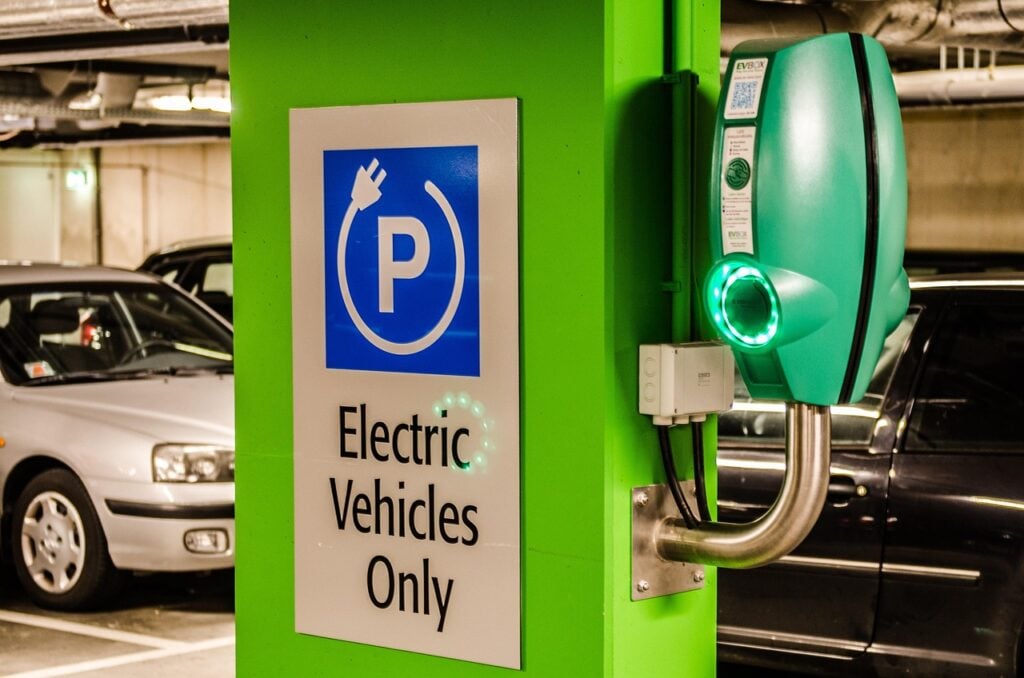
Imagine a world in which all vehicles – bar a very few – were electric. If electric vehicles were relatively cheap to buy and to run, would there be good reason to see two-car households as a bad thing?
Would there be a need to control the number of car parking spaces in new apartment developments in order to get people to use public transport, cycle or walk? Some might say yes; others might think not.
We are still a long way from that scenario. For one thing, we lack the infrastructure to enable all car owners to charge their cars as needed. Whether we have the generating capacity to sustain a total transformation from hydrocarbon to all-electric transport is a very real issue. Put simply, we don’t.
But we can imagine a world in which Ireland would be powered by a net zero renewable energy system. With a combination of solar energy, offshore and onshore wind energy and interconnectors, Ireland could become energy self-sufficient – especially if we could have access to nuclear energy as a cheap and reliable part of our energy portfolio.
The nuclear question is controversial. There are strong arguments that building a conventional large-scale nuclear reactor on the island of Ireland would be problematic from an economic and security perspective.
But the emergence of small modular reactor (SMR) technology as an option for electricity generation could be a game changer. In principle, if SMR technology were available, Ireland could become a net zero electricity economy, using such power in combination with wind and solar generation.
While Ireland is unusual in having a legislative ban on nuclear generation of electricity, the International Atomic Energy Agency (IAEA) is now co-ordinating research and development among its member states to assist them in implementing SMR plants capable of producing outputs of up to 300 megawatts.
The EU’s SMR Strategy aims to have the technology come on stream in the early 2030s. The UK has selected Rolls-Royce as a lead partner to bring commercial SMR generation on stream. Rolls-Royce is planning units with generation capacity of up to 450 megawatts. Sweden has contracted to build three such SMR facilities on its west coast.
This could be the paradigm shift that Ireland needs. Absent SMR generation, we will remain dependent on imported gas as a backup to renewables to ensure our energy security for the next 40 years. Gas importation is itself a very vulnerable strategy. Our pipeline imports come from the Moffat interconnector facility in Scotland – a point of high vulnerability. We are only now constructing long-awaited liquefied natural gas (LNG) capacity in the Shannon estuary.
It is argued – hopefully correctly – that SMR is a safer means of nuclear generation, with little or no possibility of meltdown events. SMR is regarded as a low-cost means of generation. The technology is flexible and scalable.
It will occupy one-tenth the area of a conventional reactor station. We are told that SMRs will be transported as units to relevant sites. They can be sited as needed across the national grid, avoiding large-scale grid reconstruction.
As an “always on” means of generation, SMRs could be used to complement less dependable solar and wind generation capacity. Spare capacity could be used for storage or, perhaps, hydrogen generation. Many believe hydrogen may be a necessary long-term alternative for heavy road transport needs.
With Ireland’s sky-high electricity costs and our supply vulnerabilities on the periphery of the European continent, there is every reason to begin planning now for Irish SMR power generation.
Repealing the legal ban on nuclear power generation is the first step in bringing about public awareness and consensus concerning SMR systems in Ireland. This is not a matter for boffins to work on behind closed doors in the relevant departments and ESB networks.
This is a case of being able to exploit the technology sooner rather than later. We cannot afford to take as long in this area as we have taken in other big infrastructural projects.
We have to plan now for the financing of SMR technology. We will need private partnerships in financing, construction and operation of SMRs in Ireland. Public-private partnerships delivered in the motorway construction programme, and we need similar thinking here.
The still uncompleted motorway network was and is a good thing – despite the opposition from the usual suspects who wrongly thought that railways were a viable alternative.
If road transport becomes all-electric, motorways will still be a good thing. Railways are fine and need public investment, but they are limited in effectiveness as a significant means of transport in a country such as ours.
So, while some people are still debating the ideologies of LNG and overhead pylons, let’s now face up to and plan for SMR technology in Ireland. Otherwise, we will sleepwalk into energy crises and economic disadvantage.