
History is necessarily retrospective. Politics is prospective. Good history is concerned with truth. Bad history tries to use a particular version of events for contemporary political purposes.
Of course, history is inevitably written and understood from a contemporary perspective. But good historians know that and attempt to carry out their craft in that awareness.
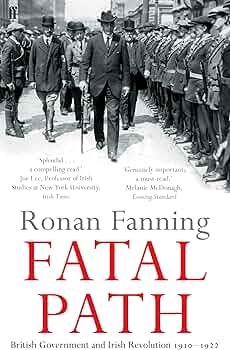
One of Ireland’s greatest modern historians, the late Ronan Fanning, wrote a magnificent history of Ireland entitled Fatal Path: British Government and Irish Revolution 1910-1922. It was published in 2013 and I feel it should almost be compulsory reading for any thinking Irish citizen who wants a clear understanding of the factors at play in the emergence of the Irish State.
Fanning, perhaps more than most historians, aspired to and achieved a sense of clarity and objectivity in his writing. He was at pains to warn his readers that writing and understanding the period from 1910 to 1922 in the aftermath of the 1998 Belfast Agreement might give rise to “a bland, bloodless and bowdlerised hybrid of history, designed to offend no one, in the pious hope that it may command unanimous acquiescence”. This was a phenomenon branded by his fellow historian Bernard Lewis as “history not as it was . . . but as they would prefer it to have been”.
In that spirit, Fanning described the interaction of physical force and democratic politics that gave birth to the independent Irish State.
His compelling analysis makes bleak reading for those who believe Redmondite nationalism was ever destined or likely to result in the non-violent creation or emergence of an independent state – or to avoid partition of Ireland in the circumstances prevailing in the early 20th century.
John Redmond’s stated ambition for Home Rule was always one of subordination to the Imperial parliament at Westminster (where fewer Irish MPs would sit than the number provided for in the Act of Union). His version of Irish autonomy was explicitly limited, at most, to the kind of devolved autonomy now enjoyed by Scotland and Wales and within the United Kingdom.
His early emotional flirtation with separatism was long extinguished when he persuaded Herbert Asquith to enact the Home Rule Bill of 1914 in the teeth of opposition from the Conservative and Unionist Party. He spoke on occasion with emotion about the new era in which Irishmen after Home Rule would regard the Empire as “their Empire” and bear arms in its global defence.
It is true that, as Stephen Collins wrote here last week, physical force or revolutionary violence was not the only factor that brought about Irish independence. However, it would be the distortion of history that Fanning warned about to suggest physical force – from the Ulster covenant crisis to the War of Independence – was not the major catalyst in the events giving rise to the independent Irish Free State.
Put another way, the political vector of Redmondite nationalism was radically different from that of the IRB and post-1916 Sinn Féin.
There is very little evidence, to put it mildly, that Ireland post-Home Rule would, or could, have exited the United Kingdom as a dominion like Canada or Australia. Equally, there is little evidence that Ireland could have had any role in the Imperial conferences that gave rise to the Statute of Westminster in 1931. This paved the way for the completion of the independent Irish Republic from 1937 to 1949.
The unvarnished truth is that the use or threat of political violence – starting with the UVF, giving rise to the Irish Volunteers, the 1916 Rising and executions, and the guerrilla War of Independence with Black and Tan counter-violence – was the decisive and determining factor culminating in the creation of the Irish Free State. It ended the United Kingdom of Great Britain and Ireland.
The difference is the distinction between what is necessary and sufficient. Of course, nascent cultural and political nationalism, particularly among Irish Catholics, was a necessary condition for Irish independence. But it by no means follows that there was an alternative, credible and non-violent path to independence in the world of 1910 to 1922.
Our independent state was neither inevitable or even probable in 1910. In my view, it could not and would not have happened without the Irish Republican Brotherhood and its campaign of physical-force guerrilla war from 1919 to 1921. By that time, there was no prospect at all of an independent all-Irish state.
Does any of this justify the use of political violence by anyone today in Northern Ireland? In my view, the answer is emphatically no. Because the constitutional dispute in Northern Ireland is between Irish people who support and oppose separation from Britain. The Troubles were a form of civil war between Orange and Green. It was never a matter of “Brits out”. Killing Irish people in pursuit of Irish reunification was, and is, wrong morally and politically. The path to Irish unity lies through reconciliation.