
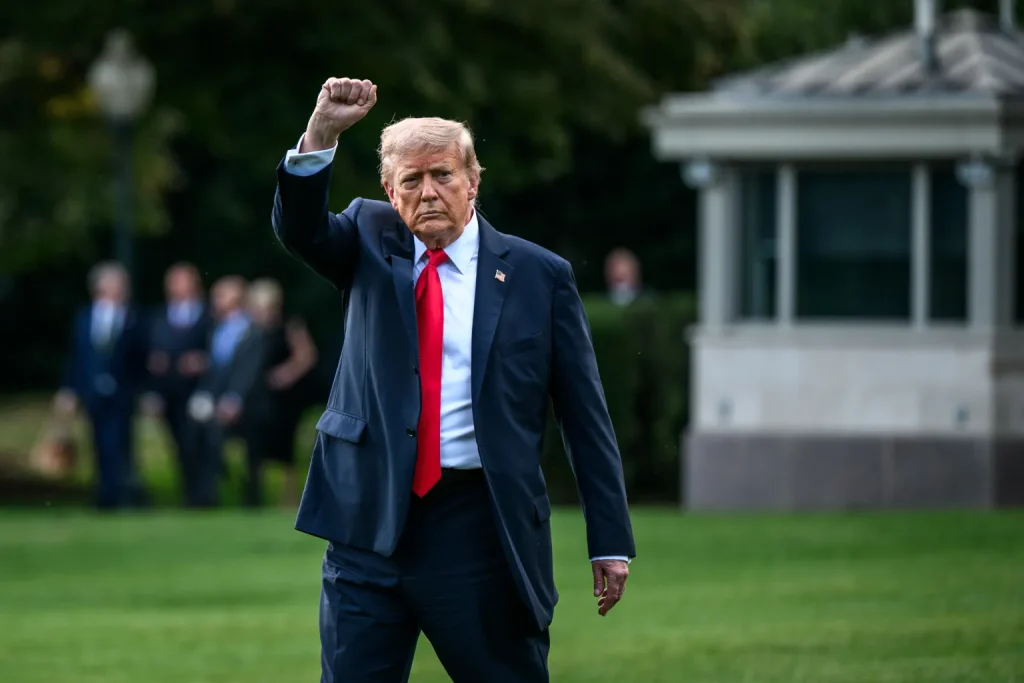
“America is, understandably, sentimentally attached to the European Continent – and, of course, to Britain and Ireland. The character of these countries is also strategically important because we count upon creative, capable, confident, democratic allies to establish conditions of stability and security. We want to work with aligned countries that want to restore their former greatness.”
With these words, the UK and Ireland are singled out for US government political attention in its recently published National Security Strategy.
“America encourages its political allies in Europe to promote this revival of spirit, and the growing influence of patriotic European parties indeed gives cause for great optimism,” the document states. That is the context for the published statements of Steve Bannon, a Trump insider, who claims he is helping to form an Irish “national party” working “behind the scenes”.
Singling out the strategy’s support for “patriotic European parties”, Bannon said: “I’m spending a ton of time behind the scenes on the Irish situation to help form an Irish national party.” He continued: “They’re going to have an Irish Maga [Make America Great Again movement], and we’re going to have an Irish Trump. That’s all going to come together, no doubt. That country is right on the edge thanks to mass migration.”
It is in that context, too, that we must understand the presence of US ambassador to Ireland Edward Walsh at the IRL Forum conference last weekend.
You don’t have to suffer from political paranoia to join up the dots. Eddie Hobbs, the organiser of the IRL Forum, is reported as saying that those seeking a new Irish government should reach across the Atlantic and seek help from the Irish diaspora, including Maga supporters. Hobbs recently participated in an online interview with Bannon, who outlined his plans.
Participants in the IRL Forum were a mixed bag. The predominantly middle-aged or older audience were treated to a melange of Catholic conservatism, pro-life rhetoric, anti-woke arguments, free speech activism and anti-immigrant politics. Loudest audience responses came for the suggestion that Ireland should quit the EU. That echoes Donald Trump’s hostility to the EU, US support for anti-EU parties across Europe, and Bannon’s stated intention to “drive a stake through the heart” of the union.
None of this might seem unduly alarming if it were not for the uncomfortable fact that the UK is currently on track, if opinion polls are to be believed, for the formation of a Reform-led government under the leadership of Nigel Farage. While nothing is certain in politics, and a week is a long time there, the next UK general election could take place in 2028, since the UK is no longer operating under the fixed-term Parliaments Act repealed in 2022. Keir Starmer and Conservative leader Kemi Badenoch are both perched on increasingly rickety thrones. The departure of one or both of them might yet alter Farage’s trajectory.
From Ireland’s point of view, the election of a Farage government would be replete with political implications, mostly negative. These include a recrudescent loyalism in Northern Ireland and mass displacement of Britain’s migrant population within the Common Travel Area. There can be little doubt that Trump and any like-minded successor will back Farage if the strategy document remains US foreign policy.
From Ireland’s point of view, US political funding, which has been so important for Sinn Féin, has the potential to dynamise a Maga-inspired political movement in this country. Although there are theoretical limits on foreign political funding, Sinn Féin has shown that existing legislation is riddled with loopholes.
Increasing US pressure over what Americans describe as freedom of speech, which is often in reality money-driven propaganda, makes the prospect of social media equivalents of political TV channels a real possibility. It is notable that GB News, which I consider an amateurish parody of Murdoch’s Fox News in the US, sent a team to report on the IRL Forum conference last weekend. The audience gave its reporter a warm welcome.
The emergence of a hard right in Irish politics was apparent to close observers during the run-up to last year’s presidential election. Hopes for the election of a candidate preferred by hard-right conservatives fell short of constitutional requirements for a valid nomination. But many of the leading participants in the IRL Forum conference were very vocal in the Spoil the Vote campaign.
There is a touch of the end of the Weimar Republic in the desire of both hard left and hard right elements of Irish politics to polarise political debate into phoney conflict between Maga conservatism and socialism in the streets and elsewhere.
With a lacklustre, floundering and underperforming Fine Gael-Fianna Fáil-dominated Government whose leaders appear to be in the political departure lounge, conditions for the currently leaderless would-be Irish Maga activists to pursue Bannon’s goal seem fertile.
An Irish Trump? Genuine Irish liberals need to wise up.