
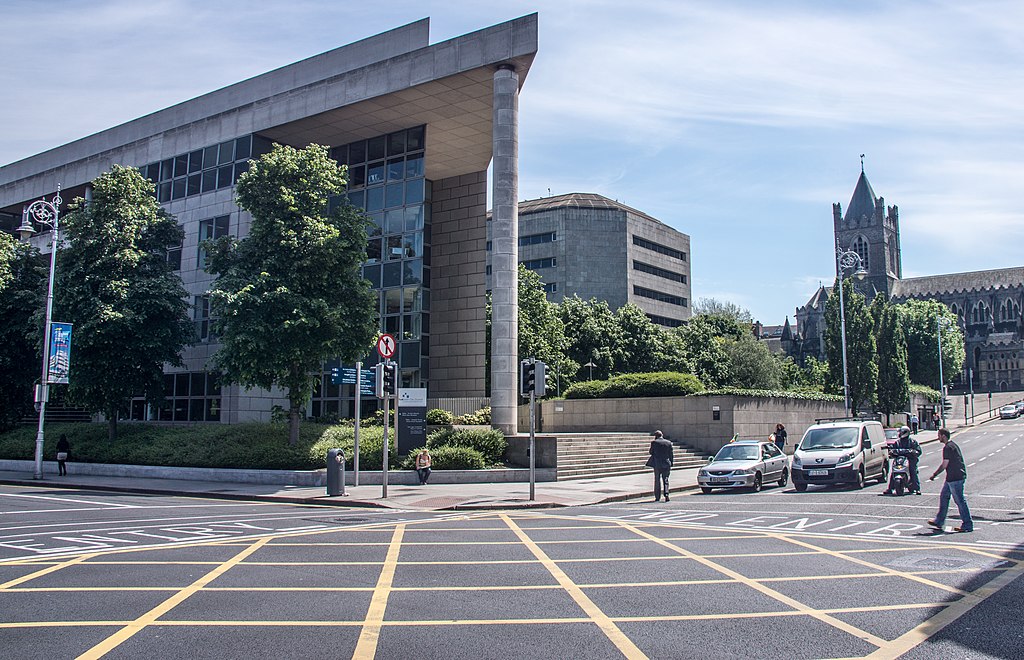
Dublin City Council is reported to be about to buy into the semi-developed Camden Yard building site on Upper Kevin Street in Dublin. Other reports suggest it could relocate there from its ghastly campus on Wood Quay, and that new civic offices would be built on the Camden Yard site, along with 300 public homes.
This news might raise the hope that Sam Stephenson’s half-built architectural monstrosity and the later ugly building on the quayside, which houses some of the council’s 6,000 workforce, will be demolished half a century after its erection.
Doubtless there will be experts who argue that the brutalist concrete melange at Wood Quay has some perverse architectural merit, which requires its preservation. And I confidently predict that the green lobby will insist that demolition at Wood Quay is environmentally unsustainable due to the carbon consequences of its destruction.
We are told that the council must get out of Wood Quay to comply with a European Union requirement that all public offices must be zero-emission structures by 2050 anyway. Is your heart sinking already? Or do you cling to the hope that a half century after Professor FX Martin tried unsuccessfully in the Four Courts to stop the Stephenson project there will be a magic wand to reverse that gross example of urban vandalism?
Will there be a happy ever after ending to this sad chapter of urban mismanagement? Or will this new translocation project end up as yet another architectural and economic debacle piled up on the present one?
Wait for the suggestions for the alternative use of the abandoned Wood Quay complex. No doubt other commentators are already imagining it in use as an artists’ commune, a nest of performance spaces and a roller-skate complex with a lot of extra public space for just hanging out. Perhaps it could house a drugs treatment unit to mirror the old one at neighbouring Merchants Quay.
I mentioned the 6,000 council employees. One of the strange things about working in the vicinity of the council’s existing office complex is the paucity of people using the steps to the main riverside entrance. Likewise, the complex has a large cavernous underground car park with a very lightly used entrance on Winetavern Street. The internal atriums never give the impression of a beehive of happy workers carrying files to and fro. The complex feels strangely sepulchral.
Many neighbours of the Wood Quay campus have the uneasy feeling that the council has become a pioneer in pushing the boundaries of working from home.
I have remarked here before that the Wood Quay complex is a striking monument to the body it houses, which is supposed to be in charge of the aesthetics of making Dublin a beautiful city. How can its planner occupants imagine that their workplace is suitable to accommodate the process of building and preserving Dublin?
Sometimes we forget the immense favour that architects and planners of Dublin did us in rebuilding O’Connell Street as a fine urban thoroughfare in the aftermath of its destruction by His Majesty’s army in 1916 and by our own home-grown patriots in 1922. They wisely rebuilt the Custom House and the GPO.
Now that our bins are collected by private enterprise, our urban water supply is handled by Uisce Éireann and our roads are reconfigured into bus and bike lanes by private contractors, many citizens may wonder how the council’s workforce has grown to 6,000. And the council recently mounted an extensive advertising campaign to recruit a new cadre of engineers. Does it need more in-house engineers?
The incredible interminable saga of Upper O’Connell Street begs another question. How is it the case that 100 years after that street was rebuilt to a very high standard, it has suffered a quarter century of dereliction?
The Ormond Hotel, a central location in James Joyce’s Ulysses, has been an ugly, derelict hole in the city’s streetscape for 20 years now. It is visible from the offices at Wood Quay. Why is that tolerated? The council has plenty CPO powers to acquire it and have a hotelier redevelop it. The same applies to the semi-derelict state of the riverside streetscape at Ushers Island, which includes the very vulnerable locus of Joyce’s The Dead. And talking about performance spaces, the council is the long-term proprietor of another row of derelict riverside buildings intended sometime for a badly needed rebuilt Abbey Theatre complex to house our national theatre.
Where is the vision? Or the implementation? Will the move to Camden Yard be completed in seven years? What will happen to the Viking remains currently entombed in the Wood Quay complex? Will there be a new Ormond Hotel? Will the Abbey Theatre be rebuilt by then? Will Ushers Island be saved and reconstructed as a coherent streetscape? Don’t hold your breath.
Photo: William Murphy, CC BY-SA 3.0 https://creativecommons.org/licenses/by-sa/3.0, via Wikimedia Commons